77 West 55th Street
New York, New York 10019 38 W 39th St. NY NY 10018
212-581-3003
24/7 Customer Support
Mon - Fri: 24/7
Always open online
Lexington Ave, Grand Central Built and Furnished Office Space for Lease/Sublease 1,700 – 5,000 SF Lexington Ave, Grand Central […]
Grand Central, Lexington Ave
W 40th St, Bryant Park, Fully Furnished Office Space For Rent 6,600 – 6,700 SF W 40th St, Bryant […]
Bryant Park, Grand Central
Fifth Ave, Grand Central, Office Space For Rent 8,050 – 10,300 SF Fifth Ave, Grand Central, Office Space For […]
Bryant Park, Grand Central
405 Lexington Ave Chrysler Building Class A Office for sublease/lease, Grand Central Station High floors – 3,200 – 7,500 […]
Grand Central, Midtown Manhattan
Vanderbilt Ave. Grand Central, NY, 42nd St, Class A Office space for lease Vanderbilt Ave. Grand Central, NY, 42nd […]
Grand Central
Fifth Ave, NYC, Fully Built & Furnished Office Space For Sublease 6,400 – 13,710 SF Fifth Ave, NYC, Fully […]
Grand Central, 5th Avenue
E 40th St, Grand Central, NYC Office Space For Rent 2,650 SF E 40th St, Grand Central, NYC Office […]
Grand Central
Fifth Ave, Grand Central, Fully Built-Out Office Space For Lease 6,100 – 11,250 SF Fifth Ave, Grand Central, Fully […]
Grand Central, 5th Avenue
Fifth Avenue, NYC, Fully Built & Furnished Office Space For Rent 2,600 – 11,000 SF Fifth Avenue, NYC, Fully […]
Bryant Park, Grand Central, 5th Avenue
Grand Central Office Space for Rent (2026): Real Prices, Deals & Insider Strategy
Grand Central Office Space for Rent (2026): Real Prices, Deals & Insider Strategy. If you are looking for Grand Central office space for rent in 2026, the first thing to understand is that this is not one office market.
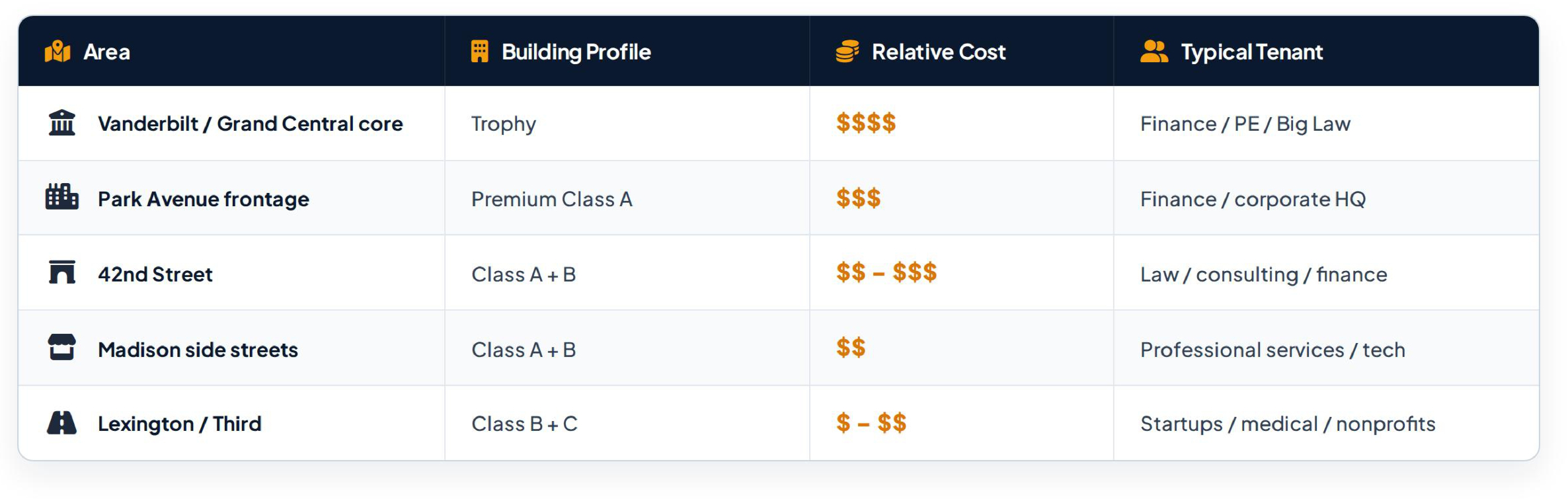
Grand Central is really several markets packed into a few blocks: trophy towers around Vanderbilt Avenue and Park Avenue, renovated Class A buildings along 42nd Street, and a much deeper value market stretching east toward Lexington and Third Avenue.
That distinction matters because the difference between a premium tower and an older Class B building can be enormous — not just in asking rent, but in availability, concessions, build-out costs, amenities, and negotiating leverage.
The other major story is the broader Manhattan recovery. Cushman & Wakefield reported that Manhattan leasing remained strong in Q2 2026, with 8.2 million SF of leasing activity, while overall vacancy declined to 19.3%. Class A continues to capture the majority of demand, reflecting the broader flight-to-quality trend.
If you are comparing Grand Central buildings today, the question is no longer simply “What is the rent?”
It is:
What quality of space do you need, what are you actually paying after concessions, and which part of Grand Central gives you the best combination of location, image and economics?
Grand Central / Manhattan
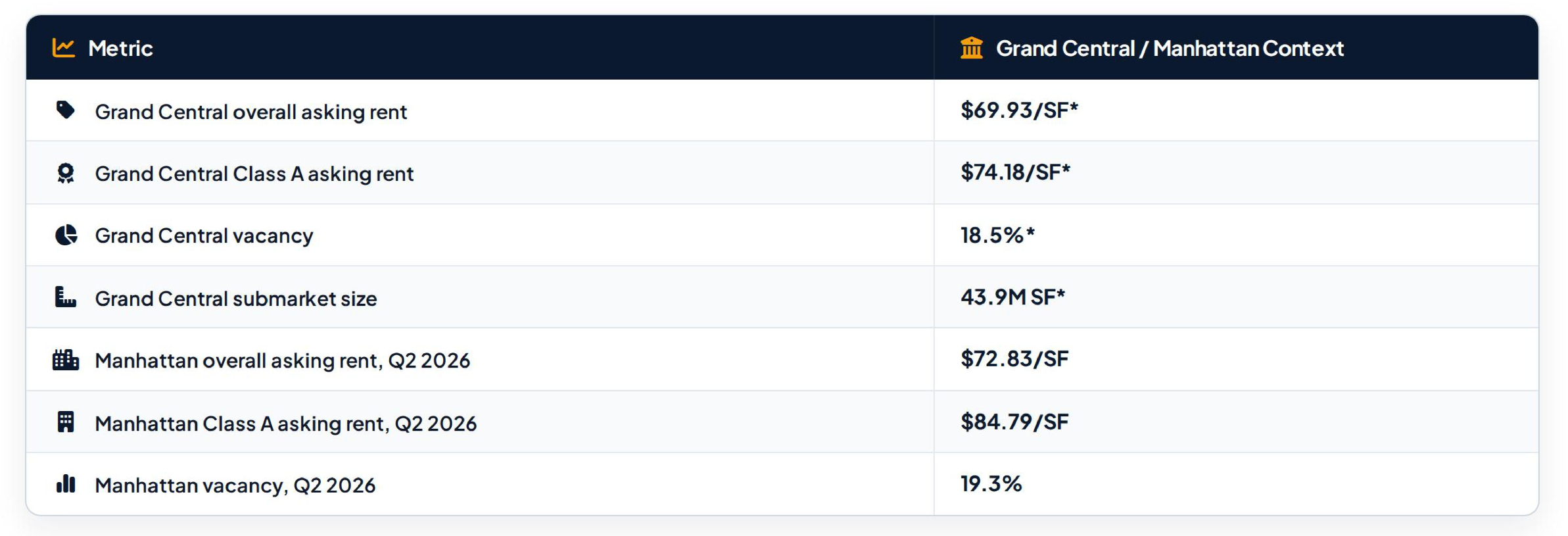
The Grand Central submarket remains one of Manhattan’s established office destinations, with 43.9M SF of office space.
Average asking rents currently stand at $69.93/SF, with Class A space averaging $74.18/SF. Vacancy in the submarket is 18.5%.
For context, Manhattan’s overall asking rent in Q2 2026 was $72.83/SF, while Class A space averaged $84.79/SF. Manhattan-wide vacancy stood at 19.3%.
Grand Central at a glance
43.9M SF of office space
$69.93/SF overall asking rent
$74.18/SF Class A asking rent
18.5% vacancy
On This Page
Grand Central has one advantage that is extremely difficult for another Manhattan neighborhood to replicate: regional connectivity.
Metro-North brings commuters from Westchester and Connecticut directly into the terminal. Grand Central Madison gives Long Island Rail Road riders direct access to the East Side. The 4, 5, 6, 7 and S subway lines converge underneath the complex, while additional subway connections are within a short walk.
But transportation is only half the story.
The second force reshaping Grand Central is the flight to quality.
Across Manhattan, tenants continue to favor higher-quality buildings with better amenities, efficient floor plates, strong building systems and better employee experience. Cushman & Wakefield says Class A properties are capturing a disproportionate share of demand nationally as occupiers prioritize location, amenities and workplace quality.
That is particularly important around Grand Central because the submarket contains an unusually wide range of buildings.
A company can lease a premium floor in a trophy tower and pay a substantial premium for the address and experience — or move a few blocks east and obtain a much more aggressive deal.
The newest and most prestigious buildings around the terminal have become the benchmark for the neighborhood. One Vanderbilt is the clearest example: its location directly above Grand Central and its premium amenities have established a different pricing tier from older surrounding buildings.
The broader Manhattan market continues to reward quality. In Q2 2026, Class A asking rents in Manhattan increased to $84.79/SF according to Cushman & Wakefield, even as overall Manhattan asking rents declined slightly to $72.83/SF.
Grand Central’s value market has not disappeared. Older Class B and C buildings can offer more availability and greater negotiating leverage, particularly for tenants willing to trade some amenities for location and economics.
The most expensive leases get the headlines, but much of the practical Grand Central market is made up of smaller and midsize requirements. That makes the neighborhood relevant not only to global financial institutions but also to law firms, professional services companies, medical practices, technology companies and growing businesses.
There is no single “Grand Central rent.”
The overall submarket asking figure is useful as a benchmark, but it can be misleading if you use it to budget a specific building.
A trophy floor, renovated Class A suite and older Class B office can all sit within walking distance of the terminal while carrying dramatically different economics.
The current market research cited for Grand Central puts overall asking rent at approximately $69.93/SF and Class A asking rent at $74.18/SF for Q1 2026.
For comparison, Cushman & Wakefield’s Q2 2026 Manhattan-wide figures show overall asking rent of $72.83/SF and Class A asking rent of $84.79/SF.
Think in terms of tiers, not one average
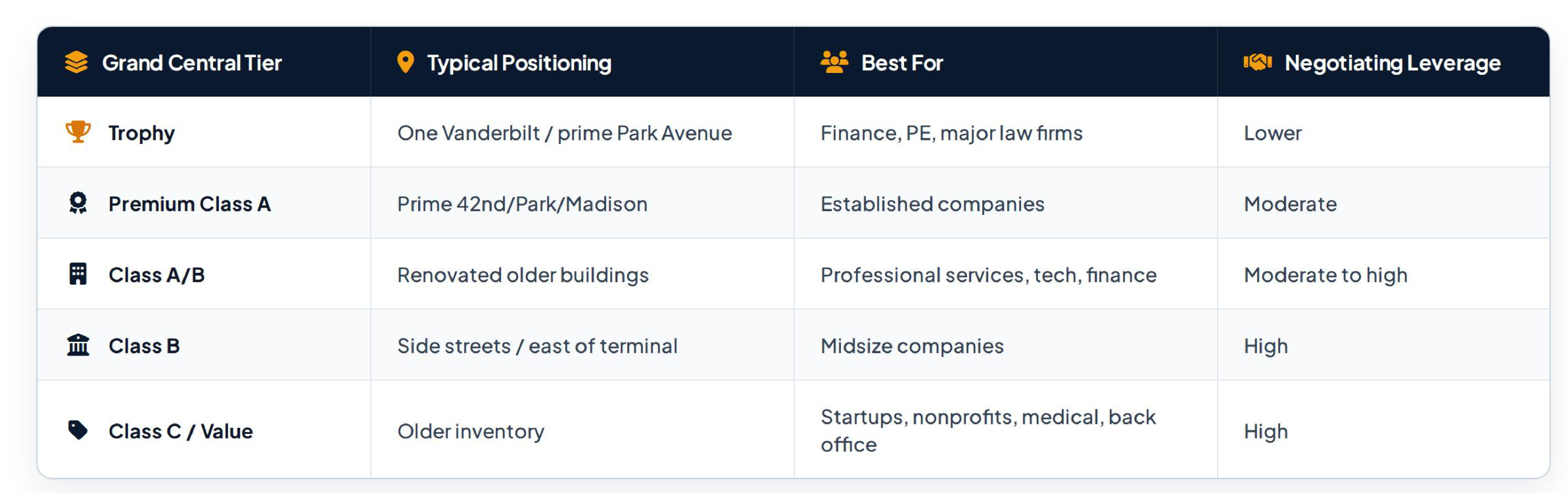
The important point is simple:
The cheapest space is not always the best deal, and the highest rent is not always the most expensive occupancy strategy.
A more expensive building may provide better concessions, more efficient space, better amenities and lower build-out costs.
Class A and Trophy Office Space
If your company needs an address that immediately communicates institutional credibility, this is the top of the market.
The flagship example is One Vanderbilt, the 1,401-foot tower directly above Grand Central. Its tenant experience, amenities and direct relationship with the terminal place it in a category of its own.
The surrounding Park Avenue buildings — including 200 Park Avenue, 230 Park Avenue and 245 Park Avenue — form the next major premium cluster.
These buildings are particularly attractive to:
The trade-off is straightforward: better address and building experience generally mean higher occupancy costs and less negotiating leverage.
Class B Office Space
For many companies, Class B is the most interesting part of the Grand Central market.
Why?
Because you can remain within a few minutes of the terminal without paying the full trophy premium.
Renovated Class B buildings can also compete surprisingly well with older Class A inventory. A landlord that has invested heavily in a lobby, elevators, common areas and spec suites may be able to offer a tenant a modern workplace without the pricing associated with the newest towers.
This is often the sweet spot for:
Class C and Value Office Space
The value market becomes more prominent as you move east toward Lexington and Third Avenue.
These buildings generally offer fewer amenities and less architectural prestige, but they can solve the fundamental problem for a cost-conscious tenant:
How do we get a Grand Central commute without paying trophy-building prices?
This tier can work especially well for:
For these tenants, the economic difference can be more important than the difference in lobby finishes.
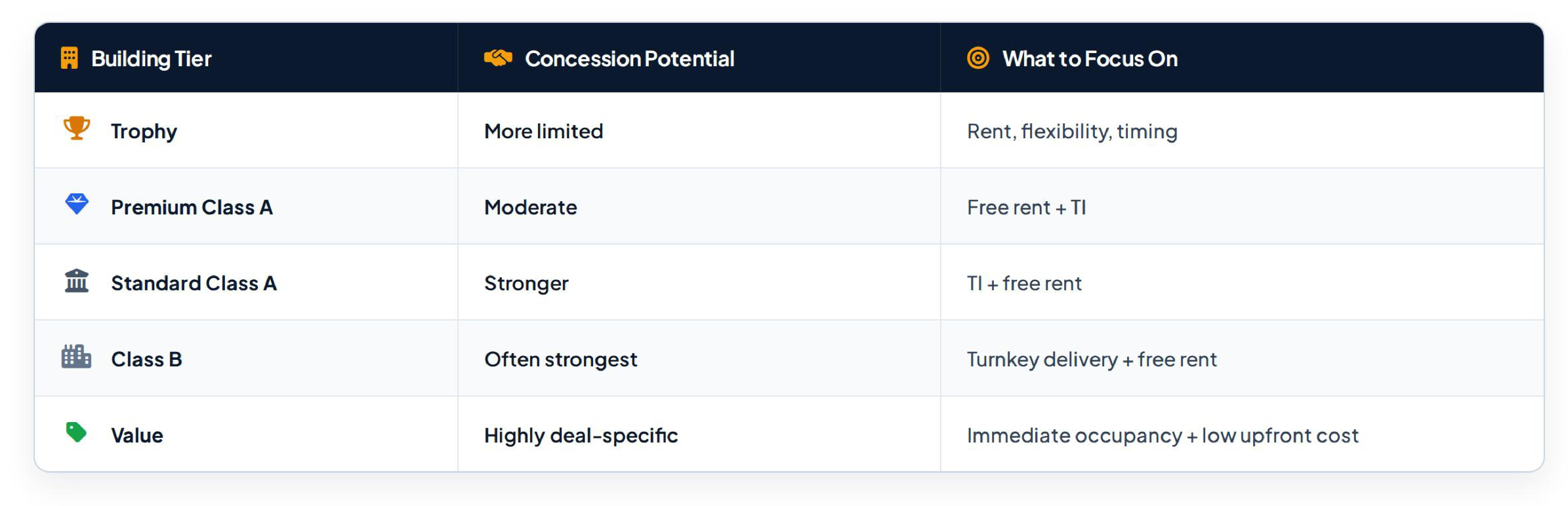
One of the biggest mistakes tenants make is negotiating only the face rent.
The real negotiation is the entire economic package.
That can include:
The current Grand Central market research cited for this guide indicates that concessions can be meaningful, particularly outside the tightest trophy inventory.
The key question
Don’t ask:
“Can you lower the rent?”
Ask:
“What is the total economic package for this lease term?”
That change in approach can materially improve the outcome.
The asking rent is only one part of the budget.
Before signing a lease, calculate the total occupancy cost.
1. Rentable vs. Usable Square Feet
NYC office leases are generally quoted on rentable square feet rather than the amount of space your employees physically occupy.
That means a tenant requiring 10,000 SF of usable workspace may need to lease substantially more rentable square footage depending on the building’s loss factor.
Always compare buildings using the same measurement basis.
2. Operating Expenses and Tax Escalations
Many office leases use a base-year structure.
If property taxes or operating expenses rise above the applicable base year, the tenant may be responsible for its proportionate share of the increase.
This is why two leases with the same asking rent can have different long-term costs.
3. Electricity
Electricity may be handled through:
Ask for the actual electricity methodology before comparing proposals.
4. Cleaning and Maintenance
Cleaning is not necessarily structured identically across buildings.
Class A properties may include more services within the operating-cost structure, while lower-tier buildings may charge separately for additional janitorial or maintenance services.
5. Build-Out Costs
This is often the largest hidden variable.
A cheap vacant office that requires a complete construction program may ultimately cost more than a slightly more expensive spec suite that is ready for occupancy.
That’s why effective rent is often more useful than face rent.
Imagine two buildings:
Building A
Building B
Building B may have the higher face rent and the lower effective occupancy cost.
This is why experienced tenants compare proposals using a full lease economics model rather than simply ranking asking rents.
Grand Central works particularly well for companies that value both commuter access and corporate positioning.
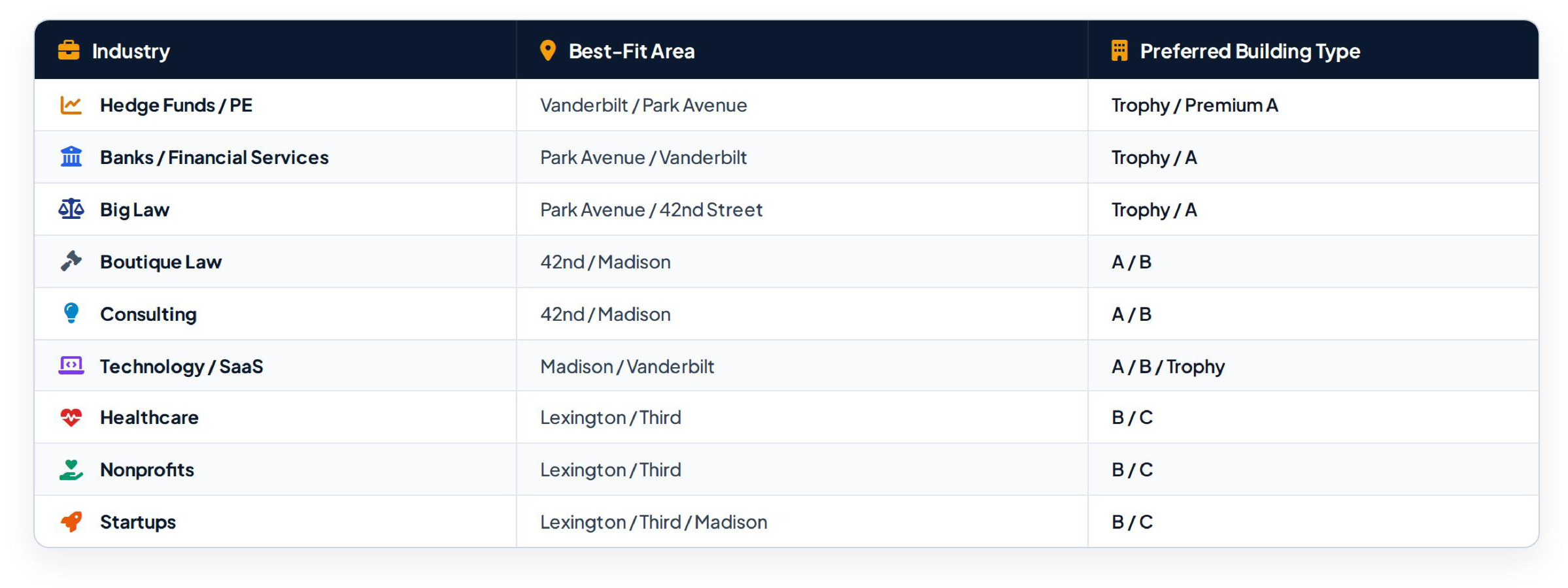
Grand Central is not Manhattan’s cheapest office market.
But for a company whose employees commute from Westchester, Connecticut or Long Island, the location can make economic sense even when another neighborhood offers a lower rent.
The question is not simply:
“Where is office space cheapest?”
It is:
“Where can we operate efficiently while minimizing commute friction and keeping the right image for clients and employees?”
Best for: Trophy tenants, financial services, major law firms and companies prioritizing prestige.
One Vanderbilt is the defining modern tower of the Grand Central district. The building sits directly above the terminal and combines a premium office environment with extensive amenities and direct transit access.
It is the building that established the top end of the neighborhood’s pricing hierarchy.
Best for: Large corporate tenants and financial services companies.
The MetLife Building occupies one of the most recognizable positions in Manhattan, directly above Grand Central and Park Avenue.
Its biggest competitive advantage is simple:
your employees can get from train to office with minimal outdoor travel.
Best for: Established corporate and professional services tenants.
The landmark Beaux-Arts building provides a very different aesthetic from the modern trophy towers while retaining the location advantages of Park Avenue.
Best for: Large financial and corporate occupiers.
245 Park is part of the premium Park Avenue cluster and has been undergoing significant repositioning, making it one of the buildings worth watching when evaluating higher-end Grand Central space.
Best for: Small and midsize tenants seeking Class A space.
One Grand Central Place is particularly interesting for companies that want a recognizable Grand Central address without necessarily requiring the economics or scale of a trophy tower.
Best for: Tenants prioritizing direct terminal access and historic character.
The Graybar is one of Grand Central’s most distinctive prewar buildings and has a direct connection to the terminal.
Best for: Companies seeking a modernized office environment immediately adjacent to Grand Central.
The building sits within the core Grand Central ecosystem and competes for tenants looking for a contemporary workplace near the terminal.
Best for: Companies where architectural identity and address prestige are major considerations.
The Chrysler Building remains one of New York’s most recognizable addresses and an iconic part of the Grand Central skyline.
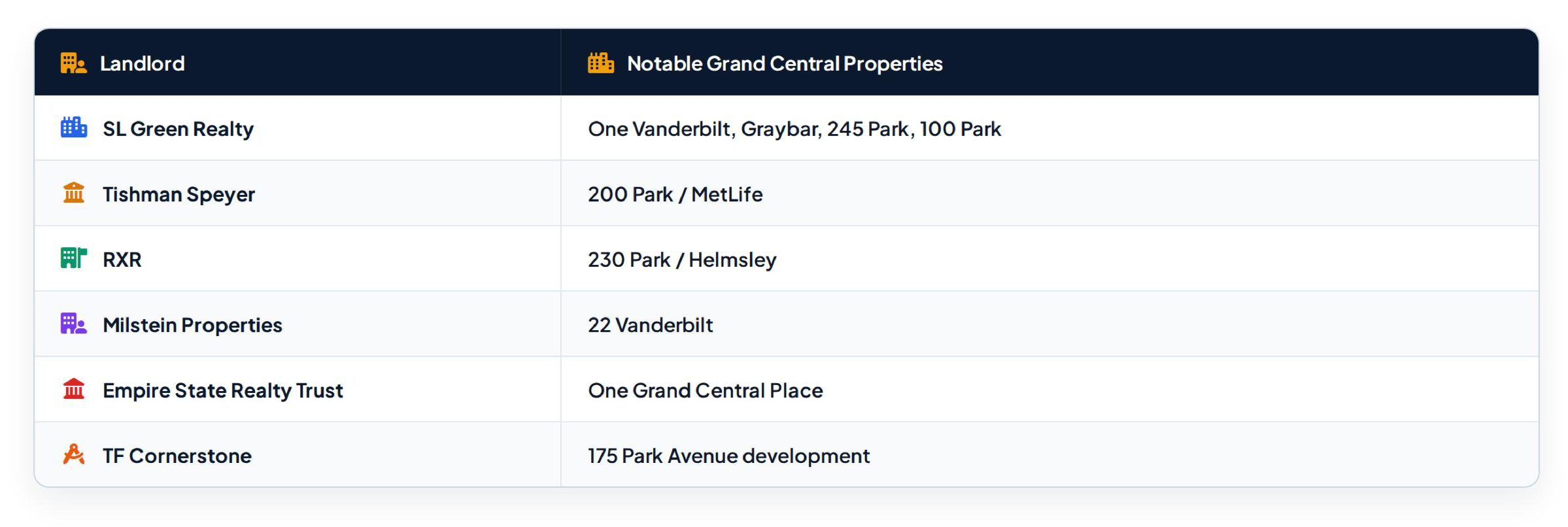
Who owns the building can matter almost as much as the building itself.
Different landlords have different portfolios, capital programs, leasing strategies and approaches to concessions.
Major names around Grand Central include:
The best Grand Central buildings are no longer competing only on square footage.
They are competing on employee experience.
Today’s stronger buildings may offer:
This is part of the broader flight-to-quality trend documented by Cushman & Wakefield. Tenants increasingly use the physical workplace as a tool for recruiting, collaboration and employee experience.
Spec suites are particularly important
For a tenant that does not want to spend six months designing and constructing an office, a furnished or partially furnished spec suite can be extremely attractive.
The premium is not necessarily about getting the lowest rent.
It is about getting operational faster.
Local Law 97 should be part of your due diligence when comparing buildings.
The law establishes building emissions limits as part of New York City’s effort to reduce operational greenhouse-gas emissions, with compliance requirements applying to covered buildings on defined schedules.
The practical takeaway for a tenant is not that every LL97 issue becomes a direct line item on the lease.
Instead, ask:
The NYC Department of Buildings maintains the official covered-building information and compliance guidance.
For a long-term lease, these questions are worth asking before selecting a building.
This remains Grand Central’s biggest competitive advantage.
Metro-North
Grand Central Terminal serves Metro-North’s Hudson, Harlem and New Haven lines, giving companies direct access to major commuter markets north of Manhattan.
Long Island Rail Road
Grand Central Madison expanded direct East Side access for LIRR commuters and significantly strengthened Grand Central’s position as a regional employment hub.
Subway
The Grand Central complex serves:
Other major subway connections are within walking distance.
Why this matters for employers
A building that is five minutes from the terminal can be meaningfully more attractive than one that is technically in Midtown but requires an additional subway transfer or a long outdoor walk.
For hybrid companies trying to bring employees back to the office, commute convenience is part of the real estate strategy.
Hudson Yards: newer development, modern towers, large floor plates and a highly amenitized environment.
Grand Central: stronger access for Metro-North and LIRR commuters and a more established corporate ecosystem.
If your workforce is concentrated in Westchester, Connecticut or Long Island, Grand Central often has the stronger transportation argument.
The Financial District can offer lower occupancy costs than prime Midtown.
CBRE’s August 2026 figures put Downtown Manhattan’s average asking rent at $61.91/SF, compared with $85.77/SF for Midtown.
But rent is only one variable.
For a company with a large northern-suburban workforce, the commute difference can outweigh some of the rental savings.
Midtown South has become one of Manhattan’s most competitive office markets, particularly for technology and creative businesses.
CBRE reported an August 2026 average asking rent of $86.34/SF for Midtown South, with availability at 16.8%.
Grand Central’s advantage is not necessarily lower rent.
It is connectivity, corporate identity and proximity to the East Side financial district.
Before touring dozens of offices, answer five questions.
1. How many people actually need desks?
Don’t automatically renew the old footprint.
Start with current headcount, hybrid attendance and realistic growth.
2. Who needs to commute?
Map employee origins before deciding which Grand Central corridor is actually optimal.
3. Do clients care about the address?
A hedge fund, law firm or investment bank may benefit more from a trophy address than a back-office operation.
4. How much construction do you want?
A turnkey spec suite can be more valuable than a larger TI allowance if speed matters.
5. What is your true occupancy budget?
Model:
Base rent + escalations + operating expenses + electricity + construction + furniture + moving costs − free rent − landlord contributions.
That number is much more useful than asking rent alone.
Yes, particularly for companies that value regional commuter access, a central Midtown address and proximity to financial and professional-services tenants.
The market is highly segmented, however. Trophy space and value space can offer very different economics.
The market research cited for Q1 2026 puts Grand Central overall asking rent around $69.93/SF, with Class A around $74.18/SF. Actual asking rents vary substantially by building, floor, condition and location within the submarket.
Yes. The amount depends on building quality, availability, tenant credit, lease term, timing and the landlord’s motivation.
The strongest negotiating opportunities are generally found outside the tightest trophy inventory.
There is no single Grand Central standard.
TI depends on the building, lease term, tenant credit, existing condition and landlord capital budget. Rather than relying on a generic allowance, request a complete economic proposal showing TI, free rent and landlord work together.
Yes. Direct leases are commonly structured around longer terms, but tenants can also consider subleases, spec suites and other flexible opportunities.
The availability of short-term space changes constantly, so a current listing search is more useful than relying on a static market average.
Absolutely. For many companies, renovated Class B space provides the best balance between Grand Central accessibility and occupancy cost.
It becomes especially attractive when the building offers a renovated lobby, efficient floor plate, good light and a turnkey suite.
It depends on your priorities. If the address itself is part of your company’s brand, a trophy building may justify the premium.
If commute convenience is the primary goal, being within a few blocks of the terminal can provide much of the same transportation benefit at a lower cost.
The best Grand Central deal rarely comes from finding the lowest asking rent. It comes from creating competition.
Start early enough to have several buildings in play at the same time. Compare multiple proposals using the same assumptions. Separate face rent from effective rent. Negotiate free rent and TI alongside the base rent. And do not overlook lease flexibility, operating expenses and future capital requirements.
In 2026, the broader Manhattan market is recovering, but it remains highly selective: Class A is outperforming lower-quality inventory, while overall availability and vacancy continue to vary substantially by submarket and building.
That creates an opportunity for a disciplined tenant.
Shop the building, corridor, landlord and lease economics. The right office may be a trophy tower above the terminal. It may also be a renovated Class B suite three blocks east that delivers a better effective deal.
The only way to know is to compare the complete economics.
We help companies compare available Grand Central offices by building class, location, asking rent, concessions, floor plate and tenant requirements.
Looking for current Grand Central availabilities or a custom 2026 office rent analysis? Contact our Midtown commercial real estate team for a curated shortlist of spaces that fit your budget, size and business requirements.
Related Articles

Compare listings
Compare