77 West 55th Street
New York, New York 10019 38 W 39th St. NY NY 10018
212-581-3003
24/7 Customer Support
Mon - Fri: 24/7
Always open online
Lexington Ave, Grand Central Built and Furnished Office Space for Lease/Sublease 1,700 – 5,000 SF Lexington Ave, Grand Central […]
Grand Central, Lexington Ave
W 40th St, Bryant Park, Fully Furnished Office Space For Rent 6,600 – 6,700 SF W 40th St, Bryant […]
Bryant Park, Grand Central
Fifth Ave, Grand Central, Office Space For Rent 8,050 – 10,300 SF Fifth Ave, Grand Central, Office Space For […]
Bryant Park, Grand Central
405 Lexington Ave Chrysler Building Class A Office for sublease/lease, Grand Central Station High floors – 3,200 – 7,500 […]
Grand Central, Midtown Manhattan
Vanderbilt Ave. Grand Central, NY, 42nd St, Class A Office space for lease Vanderbilt Ave. Grand Central, NY, 42nd […]
Grand Central
Fifth Ave, NYC, Fully Built & Furnished Office Space For Sublease 6,400 – 13,710 SF Fifth Ave, NYC, Fully […]
Grand Central, 5th Avenue
E 40th St, Grand Central, NYC Office Space For Rent 2,650 SF E 40th St, Grand Central, NYC Office […]
Grand Central
Fifth Ave, Grand Central, Fully Built-Out Office Space For Lease 6,100 – 11,250 SF Fifth Ave, Grand Central, Fully […]
Grand Central, 5th Avenue
Fifth Avenue, NYC, Fully Built & Furnished Office Space For Rent 2,600 – 11,000 SF Fifth Avenue, NYC, Fully […]
Bryant Park, Grand Central, 5th Avenue
Grand Central Office Space for Rent (2026): Real Prices, Deals & Insider Strategy
Grand Central Office Space for Rent. If you’re considering leasing office space near Grand Central Terminal in 2026, the market may look straightforward on the surface — but in reality, it’s one of the most complex and strategic submarkets in Manhattan.
Over the past 12 months, we’ve seen a major shift: companies are leasing less space, but making far more deliberate decisions. Instead of simply searching for “office space for rent,” tenants are prioritizing commute efficiency, building quality, and long-term flexibility. In many cases, this means paying more per square foot — while reducing total footprint.
Based on active leasing activity in Midtown East, tenants in the Grand Central area are consistently negotiating aggressive concession packages, including free rent and landlord-funded buildouts — but only in specific buildings and under the right conditions. The gap between Class A and Class B assets has never been wider.
This guide breaks down what’s actually happening in the market right now — including real pricing dynamics, hidden costs, and how to approach negotiations strategically in 2026.
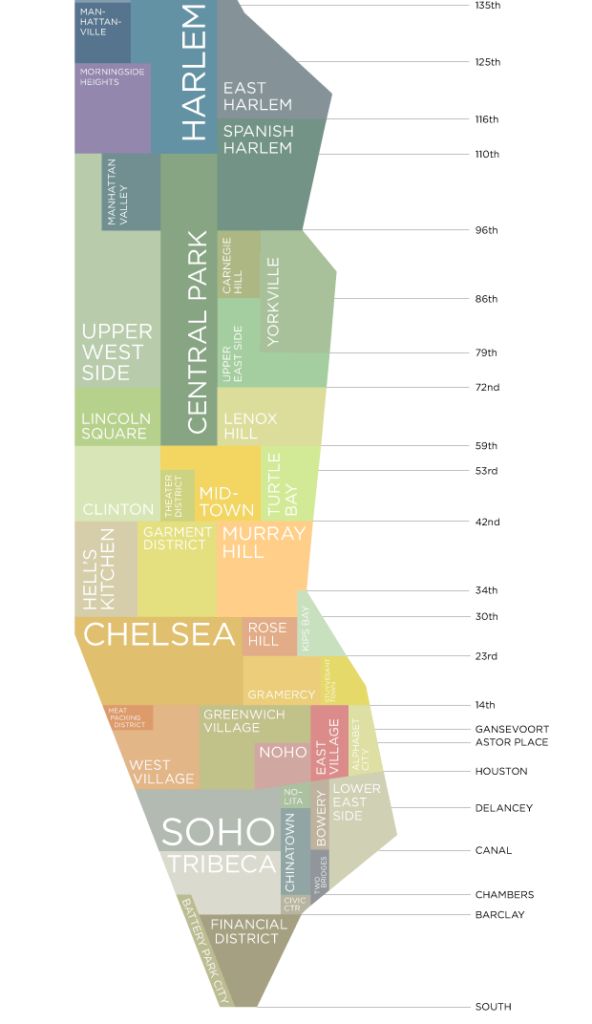
The Grand Central district (roughly 40th to 47th Street, from Second to Fifth Avenue) maintains its crown as the premier business destination for three primary reasons:
The opening and full integration of Grand Central Madison has been a game-changer. For the first time, commuters from Long Island have seamless access to the East Side, matching the convenience long enjoyed by those from Westchester and Connecticut via Metro-North. With 5 major subway lines (4, 5, 6, 7, and S) also converging here, the area is statistically the most accessible point in North America for high-level talent. In a world where “commute friction” is a top reason for employee turnover, Grand Central solves the problem better than any other hub.
Post-2024, we’ve seen a clear “flight to quality.” Companies are downsizing their total square footage but upgrading to “Ultra-Class A” spaces. They are trading 20,000 square feet of mediocre space for 12,000 square feet of premium space with terraces, floor-to-ceiling windows, and advanced hospital-grade air filtration. Grand Central, home to One Vanderbilt and the newly renovated MetLife Building, leads this global charge.
An address like 200 Park Avenue or the Chrysler Building carries global weight. For law firms, private equity groups, and hedge funds, the prestige of the neighborhood is a vital part of client trust. Furthermore, the “corporate clustering” effect means you are literally steps away from the world’s largest banks, legal powerhouses, and consulting firms.
The market in 2026 is highly bifurcated. While Class B and C spaces offer historic deals for budget-conscious firms, Class A+ rents are reaching record highs due to scarcity in the newest towers.
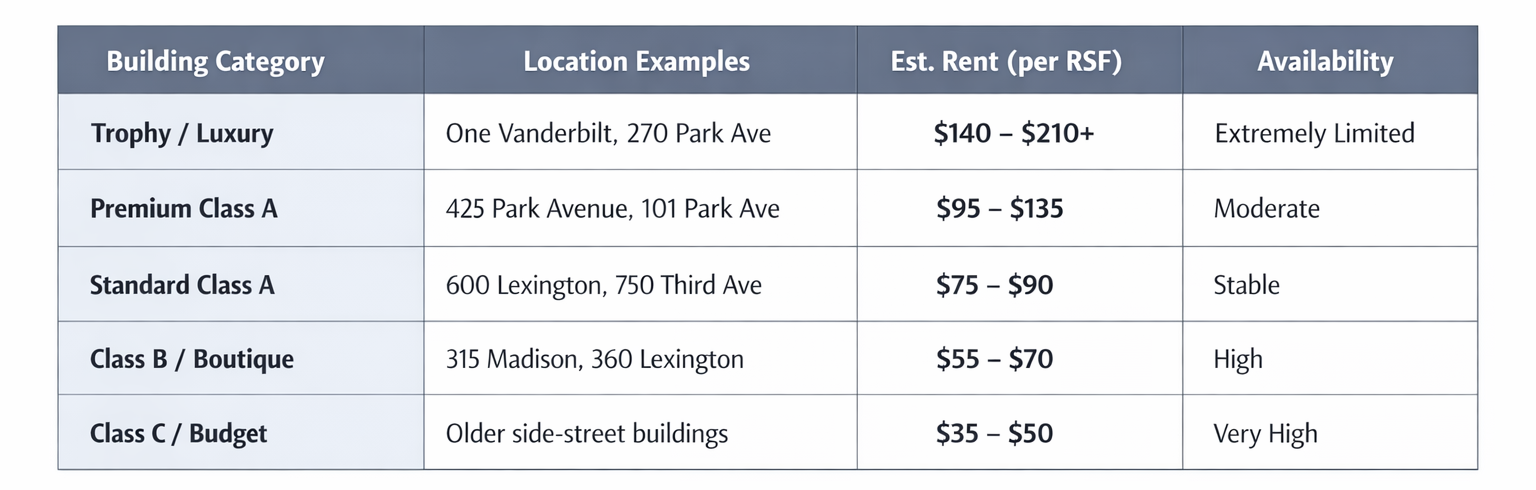
In the Grand Central market, the sticker price is rarely what you actually pay. To avoid budgeting errors, sophisticated tenants factor in these four critical elements:
The Loss Factor (27%–32%)
In NYC, you pay for the Rentable Square Footage (RSF), which includes your share of the building’s common areas (lobbies, hallways, mechanical rooms). The actual “carpetable” space is the Usable Square Footage (USF). If your company requires 10,000 sq. ft. of actual office space, you will likely need to sign a lease for approximately 13,000 RSF.
Operating Expense Escalations (OPEX)
Most commercial leases include a “base year” for property taxes and operating expenses. If the building’s taxes or union labor costs rise in year two or three, the tenant is responsible for their proportionate share of that increase. In 2026, with rising energy costs, this can add $2–$5 per foot to your annual budget.
The “Electricity Factor”
Electricity is rarely included in the base rent. It is usually handled in one of three ways:
Cleaning and Maintenance
While Class A buildings usually include nightly cleaning in the rent, Class B and C buildings often treat this as an additional service. Always clarify if “garbage removal” and “janitorial services” are part of the core package.
Lease Structures: NNN vs. Modified Gross
In Grand Central, most leases are Modified Gross, meaning the landlord pays for the base year’s taxes and insurance. However, some boutique buildings or ground-floor retail spaces may use a Triple Net (NNN) structure, where the tenant pays for everything. Understanding the difference is vital for your P&L statement.
In recent transactions near Grand Central Terminal, tenants leasing between 5,000 and 15,000 RSF have typically reduced their footprint by 25–40% compared to pre-2020 leases, while upgrading to higher-quality buildings.
For qualified tenants, landlords in Class A properties are currently offering:
However, these incentives are highly dependent on timing, credit strength, and the specific asset — meaning two similar spaces can have dramatically different deal structures.
If you are a landlord or a sub-lessor, your space must compete with “Work-from-Home” comforts. The most successful offices near Grand Central now feature:
Is it possible to find short-term leases (1–3 years)?
Yes. While 5–10 years is the standard for direct leases, the 2026 market is rich with sublease opportunities from firms that have moved to hybrid models. Additionally, many “spec suites” offer flexible 3-year terms.
What is a “Tenant Improvement Allowance” (TIA)?
This is the capital a landlord provides to build out your office. In the current Grand Central market, TIA for a 10-year lease can range from $90 to $150 per square foot, covering everything from drywall to high-end lighting.
How has Local Law 97 impacted rents?
NYC’s Local Law 97 penalizes buildings with high carbon emissions. Newer or retrofitted buildings near Grand Central are “green-compliant,” helping tenants avoid secondary costs and meet their own ESG (Environmental, Social, and Governance) goals.
The Grand Central office market remains the most resilient and prestigious submarket in the world. By choosing a location here, you are prioritizing your employees’ time, your company’s image, and your access to the global financial engine.
To secure the best deal in 2026, we recommend starting your search 9 to 12 months before your current lease expires. This timeline allows you to leverage multiple landlords against each other to maximize concessions like free rent and construction allowances.
Looking for a curated list of off-market availabilities or a custom 2026 Grand Central Rent Report? Contact our Midtown commercial real estate experts today for a private consultation.
In this region, Grand Central Terminal is a primary transportation hub. It serves Metro-North trains and the East Side 4, 5, and 6 local and express subway lines. Grand Central acts as a central core for transit in Midtown Manhattan, offering rail, subway, bus, taxi, and airport service all within steps of the Main Concourse. Grand Central Terminal main entrance is 89 E. 42nd Street (at Park Avenue), New York, NY 10017. It is accessible via the 4, 5, 6, 7, and S subway lines, the M101, M102, M103, M1, M2, M3, M4, Q32, and M42 buses and the Hudson, Harlem, and New Haven lines on Metro-North.
| Grand Central–42nd Street |        |
.
Related Articles



Compare listings
Compare